Thomas More
The King's CurseThomas More occupies a strikingly double position in the narrative: he is a practical servant of the royal household, trusted with matters of health and government, yet also a man whose conscience ultimately sets a limit on obedience to Henry VIII. His movement from valued adviser to condemned opponent makes his life a measure of the widening conflict between royal authority and the Church, while his memory continues to shape Margaret Pole’s understanding of later losses.
Identity and Place at Court
More is presented as a lawyer whose learning and judgment bring him unusually close to the center of government. He becomes a trusted intermediary between Henry VIII and Thomas Wolsey, and is described as Wolsey’s favorite. At a time when the king will not receive documents or be seen, business passes through Wolsey and his expanding household; More’s position between cardinal and king gives him influence in a court where access itself is a form of power.
When Wolsey falls and the Howard faction becomes dominant, More remains, in Margaret’s assessment, the king’s one good adviser. He serves at Henry VIII’s side through the day but tries to return to the City to be with his family. The narrative’s account of his public authority is thus joined to a glimpse of an ordinary domestic allegiance: he is not only a royal counselor but a husband and father, and his service repeatedly competes with the wish to be home.
Public Service and Personal Connections
During an epidemic, More is entrusted with protecting the health of the court. He orders households with a sick member to display a bundle of hay at the door, a visible warning intended to keep others away. The measure is controversial: people complain that it marks out and persecutes the poor. Margaret, however, writes to thank him for caring for the king. When she hears that More himself is ill, she sends him a bottle of oils she has distilled, said to reduce fever, in a basket of medicines carried to him at Abingdon, near Oxford.
The episode shows Margaret’s attentiveness to political proximity as well as personal kindness. When her son Montague questions why she is sending precious medicine to More, she explains that a favorite of Wolsey is close to the king, and that she wants him to think kindly of her family. Their connection is therefore both practical and warm: she recognizes the value of his access, but the later recollections of his friendship show that he is more to her than a useful court contact.
More’s dealings with Margaret’s son Reginald also include intellectual exchange. He tells Margaret that he is writing a long essay in reply to Reginald’s work, apologizing for the delay because he has been writing so many letters for the king that he has had too little time for his own. The exchange places More within a circle of scholarly correspondence even as royal demands consume his working hours. In a separate conversation with Margaret, he reflects on a child’s duty of obedience to a parent and mentions that his own daughter accuses him of special pleading when he teaches his children the same lesson. The detail lends personal texture to the learned courtier: he speaks as a father, and Margaret remembers both his humor and his sympathy.
Counsel and the Limits of Service
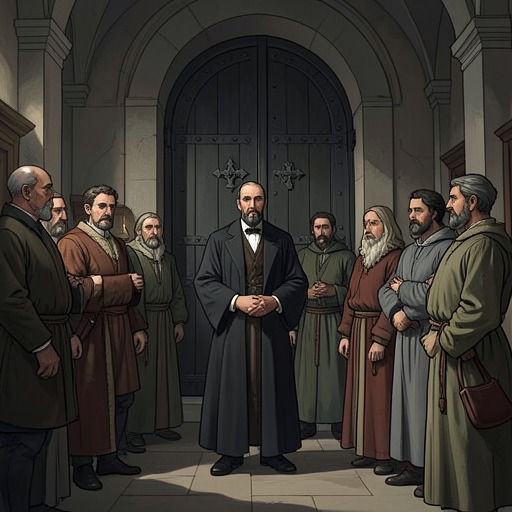
Henry VIII confides to More his belief that his marriage is invalid. He presents the deaths of his children as signs that the marriage is not blessed by God and distinguishes his case from that of his sister, Margaret, the Dowager Queen of Scotland. More, though privately doubtful about the divine origin of the king’s revelation, promises to form a considered legal opinion and advise his master. The confidence placed in him is substantial, but the account also marks the strain between legal judgment and a royal conclusion already invested with religious meaning.
The conflict becomes public when the peers are summoned to Westminster Palace to take the oath of succession, administered by Thomas Cromwell, now Lord Chancellor. Margaret thinks of More’s refusal and recalls that he was prepared to sign a revised version: he did not disagree with much of the oath, but could not sign it as it stood. His response is not represented as a rejection of every provision. Rather, the distinction he makes between a text he might accept and the exact oath demanded from him becomes the boundary on which his position turns.
Henry VIII had promised that he would never put More to this test, but the king breaks that promise. The breach gives the dispute a personal as well as constitutional force: More had been a friend whom the king loved, and his refusal now exposes the cost of the king’s demand for assent. When the Church submits to the king and royal authority displaces the Pope’s authority in England, More returns the seal of Lord Chancellor, resigns, and goes home. His departure is the visible end of a public career that had depended on service to the crown; the oath crisis reveals that service cannot reconcile the competing claims of king, Church, and conscience.
Refusal, Death, and Memory
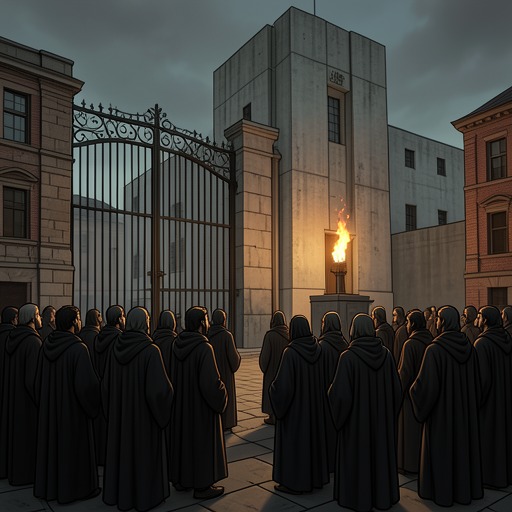
In July, after writing, praying, and thinking, More concludes that there is no way to satisfy both God and the king. He leaves his cell, walks to Tower Hill, and lays his head on the block rather than deny his Church. The narrative presents his death not as a sudden gesture but as the outcome of sustained reflection and an irreconcilable choice. His resignation had already shown that he would not continue in office under the new settlement; his execution makes the price of that refusal final.
More’s death remains present in later scenes. When Margaret searches a royal gathering for Montague and finds him absent, she remembers an earlier occasion when More told her that her son had been exiled from court. Now More is gone, and she again does not know whether her son is safe. His former role as a bearer of painful news becomes part of the way she experiences a new threat: his absence is not simply personal loss, but the loss of a trusted figure who once helped her understand what was happening at court.
At the Shrine of Thomas Becket at Canterbury, pilgrims recall More alongside John Fisher as a man who died for his faith rather than accept the king as head of the Church. Their recollection connects More’s death to an older story of a churchman killed by a king, and gives his refusal a public meaning beyond the court. Later, Henry VIII says that More should still be alive and that Montague should have died in his place. The comparison exposes the violence of the king’s shifting judgments: the adviser he once loved becomes, in retrospect, a life he wishes he had spared, while Margaret’s son is cast as the substitute victim. Margaret, looking back across those deaths, includes More among those she believes she failed to defend. In her account, his memory joins political resistance to grief, and his choice remains an enduring example of the cost of refusing to make conscience yield.